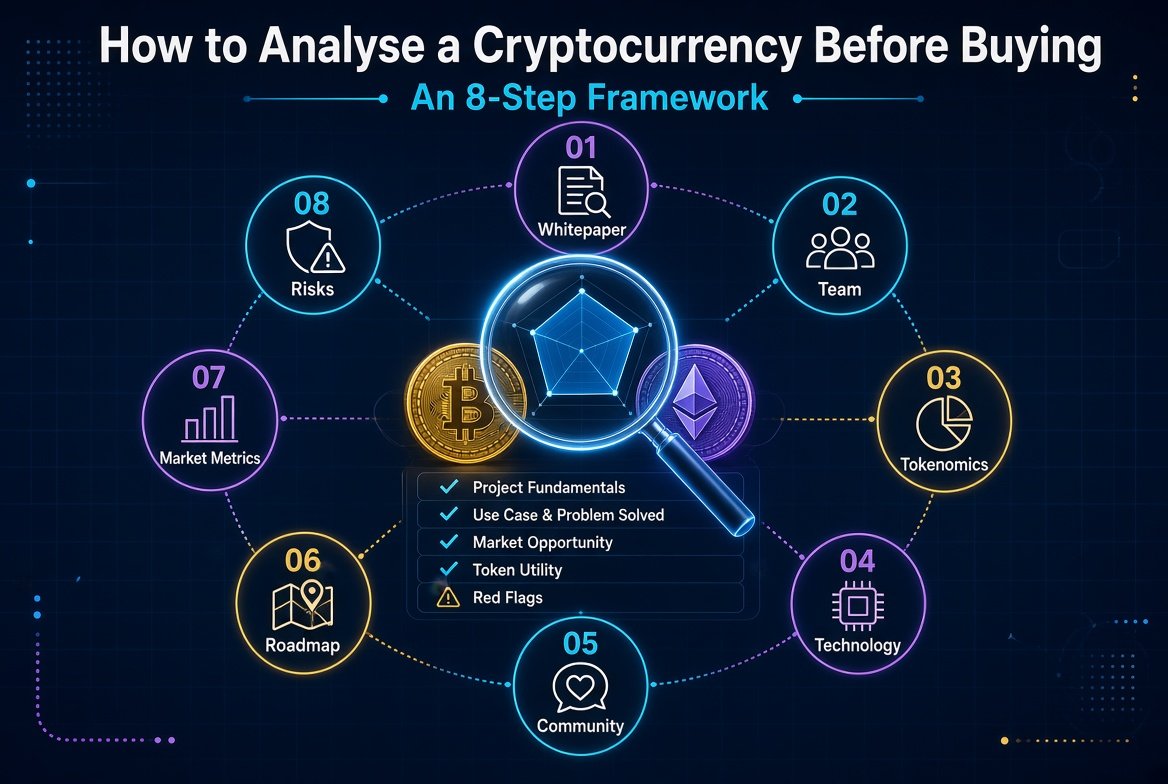
Most crypto losses are not caused by bad luck. They are caused by buying without understanding what you are buying. This guide gives you a practical, step-by-step framework to evaluate any cryptocurrency before putting money into it.
Why Research Matters More in Crypto Than Anywhere Else
In traditional investing, you buy shares in a company with audited financial statements, regulatory filings, and years of operating history. In crypto, you are often evaluating a project that is six months old, has a twelve-person team, and operates entirely through code.
This creates enormous opportunity and enormous risk. The same market that produced 100x returns on Solana also produced thousands of projects that went to zero. The difference between the two, in most cases, comes down to quality of research.
The framework below will not guarantee profits. Nothing does. But it will help you spot red flags, avoid obvious traps, and make decisions based on evidence rather than hype. Before diving in, if you are completely new to the space, it helps to first understand what Bitcoin is and how the broader crypto market works.
Step 1: Understand What the Project Actually Does
Before anything else, you need to understand what problem this cryptocurrency is trying to solve and whether that problem is real. Ask yourself: what does this blockchain or token actually do? If you cannot explain it in two sentences, either the project is too complex to understand or the marketing is designed to confuse — both are red flags.
Who are the intended users? Is there an identifiable audience that would genuinely benefit from this? Does the solution actually require a blockchain, or could the problem be solved just as well without one?
Where to look: The project’s official website, their whitepaper, and explainer threads from credible analysts on Twitter/X.
Red flag: Heavy on buzzwords like “revolutionary” and “next-generation” but light on specifics of what it actually does day to day.
Step 2: Read the Whitepaper
A whitepaper is a formal document that explains the project’s technology, purpose, tokenomics, and roadmap. As a beginner you do not need to grasp every technical detail. Focus on these sections:
- Problem statement: Is the problem described clearly and specifically?
- Solution: Does their proposed solution make logical sense? Does it require a token?
- Token utility: What does the token actually do inside the ecosystem?
- Team section: Are the founders named? Do they have a verifiable track record?
- Roadmap: Are goals specific and time-bound, or vague and aspirational?
Where to look: The project’s official website, or search the project name followed by “whitepaper PDF.”
Red flag: No whitepaper at all. A whitepaper clearly copied from another project. A whitepaper with no team names or no token utility described.
Step 3: Research the Team
In crypto, the founding team is often the single most important factor in whether a project succeeds or fails. Technology can be copied — a talented, honest team with a track record is rare.
Are the founders publicly identified? Search each founder on LinkedIn. Have they worked at credible companies? Do they have experience in crypto, finance, or software engineering? Have they built and shipped anything before? A team that has delivered working products previously — even small ones — is far more credible than a team making their first attempt.
Where to look: LinkedIn, Twitter/X, GitHub profiles, and search the founder’s name plus “crypto” to find any history of past projects.
Red flag: Completely anonymous team on a brand-new project with no track record. Founders with very recently created social profiles. Teams promising to reveal their identities later.
Step 4: Analyse the Tokenomics
Tokenomics — the economics of a token — is the most overlooked factor by beginners and the most studied by professional investors. Even an excellent project can be a terrible investment if the tokenomics are designed against regular holders.
| Factor | What to Check | Why It Matters |
|---|---|---|
| Total vs. Circulating Supply | How many tokens exist vs. how many are currently tradeable | Large unreleased supply creates future selling pressure on price |
| Team Allocation | What percentage do founders and early investors hold | Above 25% is a warning sign — they can dump on the market |
| Vesting Schedule | When do early holders’ tokens unlock and become sellable | Large unlock events often precede significant price drops |
| Inflation Rate | Are new tokens continuously being created as rewards | High ongoing inflation dilutes the value of your holdings |
Where to look: CoinGecko, CoinMarketCap, the project’s official tokenomics page, and Messari.io for detailed breakdowns.
Red flag: Very high team allocation with a short vesting period. No public tokenomics documentation. A mint function still active — meaning developers can create new tokens at will.
Step 5: Check On-Chain Data
On-chain data is information publicly visible on the blockchain itself. It shows you what is actually happening with a project, regardless of what the marketing claims.
- Daily Active Addresses: How many unique wallets are actively using this blockchain each day? Rising numbers suggest genuine adoption.
- Transaction Volume: How much real value is being transferred? High and growing volume signals actual utility.
- Developer Activity: GitHub commit history shows whether the team is actively building. No updates for months is a serious concern.
- Holder Distribution: Are 10 wallets holding 80% of the supply? Those whales can move the price dramatically at any time.
Where to look: Etherscan for Ethereum tokens, Solscan for Solana tokens, DeFiLlama for Total Value Locked in DeFi protocols, and GitHub for developer activity.
Red flag: Low and declining on-chain activity despite strong marketing claims. Highly concentrated token holdings in a few wallets. No visible GitHub activity for months.
Step 6: Assess Market Cap and Growth Potential
A coin’s price alone tells you nothing useful. What matters is market cap — the total value of all tokens in circulation.
Market cap = price x circulating supply
If a coin has a market cap of $50 million and you want 10x returns, the market cap must grow to $500 million. Is that realistic? Compare it to similar, established projects in the same category. If comparable protocols are valued between $500 million and $2 billion, a $50 million cap may have legitimate upside.
This is why smaller-cap coins with legitimate fundamentals can offer asymmetric upside that larger coins like Bitcoin or Ethereum simply cannot provide at their current size.
Where to look: CoinGecko and CoinMarketCap both display market cap clearly on every coin page.
Step 7: Check Community and Social Presence
Community is a real signal of genuine interest and long-term viability. Quality matters far more than quantity. A 50,000-member Telegram with real, engaged people asking technical questions is more valuable than a 500,000-member group full of price speculation.
Check the project’s Discord or Telegram yourself. Are developers actively responding to questions? Or is it all hype?
Where to look: The project’s official Discord, Telegram, Twitter/X, and Reddit. Search the project name on Reddit to find both positive and critical discussions.
Red flag: Communities that aggressively silence critics or ban users asking legitimate questions. Heavy undisclosed paid influencer promotion.
Step 8: Understand the Current Market Narrative
In crypto, price is often driven by narratives — the story the market tells about why a particular sector is valuable right now. A strong project in a strong narrative has two forces working in its favour. A strong project in a dead narrative often stays cheap despite its quality.
In 2026, the strongest active narratives include:
- AI + Crypto: Projects combining artificial intelligence with blockchain infrastructure
- Real World Assets (RWA): Tokenising physical assets like real estate, bonds, and commodities
- Layer 2 Solutions: Making blockchains faster and significantly cheaper to use
- DePIN: Decentralised Physical Infrastructure Networks using token incentives to build real-world networks
Research Priority Scorecard
After evaluating a project across all eight steps, use this table to prioritise your findings. Projects with weak scores on high-priority factors should be avoided regardless of how exciting the pitch sounds.
| Research Factor | Priority Level |
|---|---|
| Clear problem and working solution | High — must pass |
| Credible, verifiable team with track record | High — must pass |
| Healthy tokenomics with fair distribution | High — must pass |
| Active and growing on-chain metrics | Medium |
| Reasonable market cap headroom for your target return | Medium |
| Strong current narrative supporting the sector | Medium |
| Quality, engaged community | Supporting |
What to Do After Your Research
Research does not end with a buy decision. Once you invest, continue monitoring whether development milestones are being hit, whether on-chain activity is growing or declining, whether any major token unlocks are approaching, and whether anything has changed with the team or roadmap.
Set a clear rule: if three of your original investment thesis points no longer hold true, reassess your position. And once you have chosen a project to invest in, make sure you also have a clear plan for managing risk — our guide on crypto risk management covers position sizing, stop-loss rules, and how to protect your capital.
Frequently Asked Questions
How long should I spend researching a project?
For any investment of meaningful size, spend at least 2 to 3 hours researching across multiple independent sources. The crypto market will always have another opportunity. Missing one is far better than losing your capital in a bad project.
What if I cannot find a whitepaper?
Treat the absence of a whitepaper as a significant red flag. Any serious project documents its technology and economics. If it does not, be very hesitant to invest.
Is a high price the same as a high market cap?
No. A token priced at $0.001 can have a higher market cap than one priced at $500, if there are enough tokens in circulation. Always check market cap, not just price — price alone is meaningless without knowing the total supply.
Should I trust crypto influencers on YouTube or Twitter?
Be very sceptical. Many influencers are paid to promote projects they hold, sometimes disclosed and often not. Always cross-reference any recommendation with your own independent research before acting on it.
How do I know if on-chain data looks healthy?
Compare it to similar projects of similar size and age. If a project claims to have 100,000 users but shows only 2,000 daily active addresses on-chain, those numbers do not add up and deserve serious scrutiny.
Disclaimer: This article is for educational purposes only and does not constitute financial advice. Cryptocurrency investments carry significant risk. Always conduct your own research before making any investment decisions.