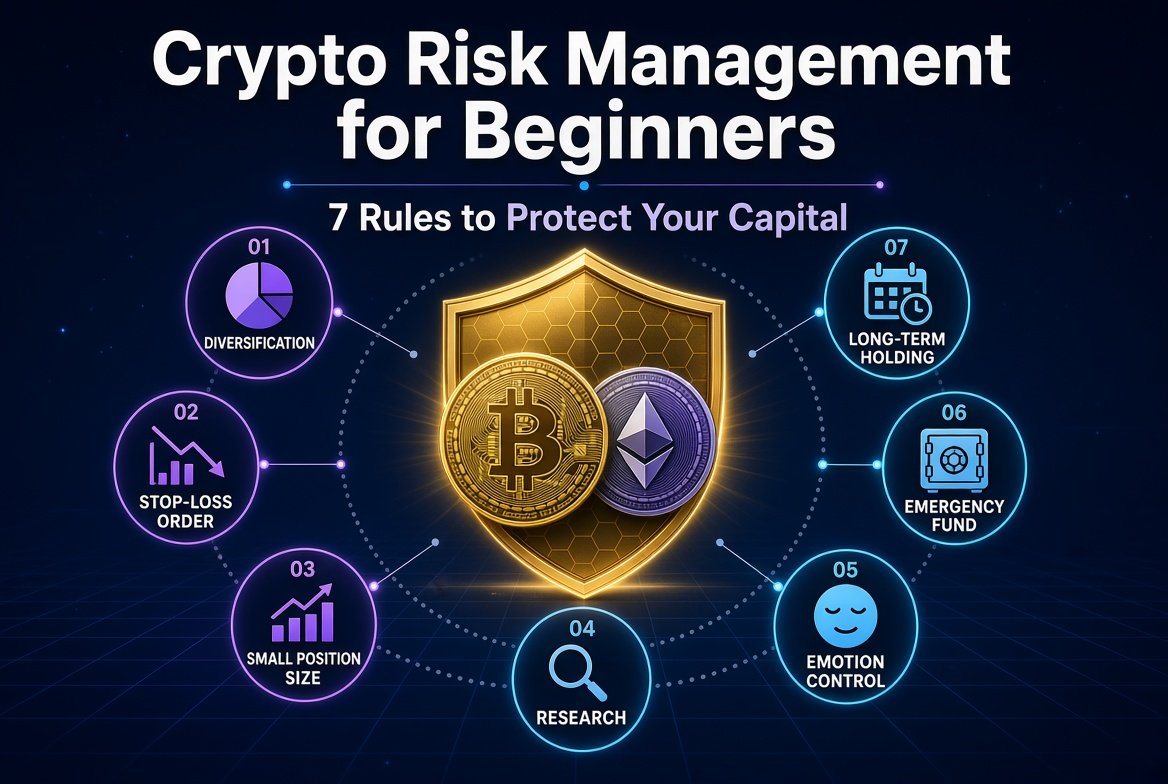
Most people who lose money in crypto do not lose it because they picked the wrong coin. They lose it because they bet too much, had no plan, and panicked at the wrong time. Risk management is not glamorous but it is the skill that keeps you in the game long enough to win.
Why Risk Management Is the Most Important Skill in Crypto
Crypto is one of the most volatile asset classes in history. Bitcoin has fallen 80% from its peak twice. Individual altcoins regularly drop 90 to 95% from their highs. Projects that looked promising have disappeared overnight.
None of this means you should not participate. It means you should participate intelligently, with a clear framework for how much you are willing to risk, on what, and under what conditions.
Studies consistently show that the majority of active crypto traders lose money. The rare long-term winners are usually those who managed risk better than everyone else, not those who predicted prices better.
Rule 1: Only Invest What You Can Afford to Lose Entirely
“Afford to lose” does not mean money you would be unhappy losing. It means money whose complete disappearance would not affect your housing, food, emergency fund, or basic financial stability.
Before putting a single penny into crypto, make sure you have:
- 3 to 6 months of living expenses in a separate savings account you do not touch
- No high-interest debt — the interest on credit cards almost always outpaces realistic crypto returns
- Other savings and investments if you are treating crypto as part of a broader financial plan
A common starting guideline: many financial planners suggest allocating no more than 5 to 10% of your investable portfolio to high-risk assets like crypto.
Rule 2: Diversify, But Not Into Everything
True diversification in crypto means spreading risk across assets that do not all behave identically. It does not mean owning 30 different altcoins. Use the Core-Satellite approach:
| Allocation Type | What to Hold | Suggested % of Crypto Portfolio |
|---|---|---|
| Core | Bitcoin (BTC) and Ethereum (ETH) | 60 to 70% |
| Satellite | 3 to 5 carefully researched altcoins | 20 to 30% |
| Speculative | Higher-risk small-cap projects (optional) | 0 to 10% |
This structure means that even if all your altcoin picks fail completely, the majority of your crypto portfolio survives. Each project you add also requires ongoing monitoring. Most people cannot track 20 altcoins effectively, and neglected positions lead to bad decisions.
Rule 3: Position Sizing
Position sizing is the discipline of deciding exactly how much of your portfolio to allocate to each individual investment. It is one of the most powerful tools for protecting yourself from catastrophic loss.
| Asset Type | Suggested Allocation | Reasoning |
|---|---|---|
| Bitcoin (BTC) | Up to 30 to 40% of crypto allocation | Most established, most liquid, lowest relative risk |
| Ethereum (ETH) | Up to 20 to 30% of crypto allocation | Strong fundamentals, large ecosystem, proven track record |
| Researched altcoins | 5 to 15% per position | Enough upside to matter. A loss will not be devastating. |
| Higher-risk small caps | 1 to 5% per position | Treat as high-risk bets, not core holdings |
The key principle: no single altcoin should be large enough that its failure is devastating. Before each investment, ask yourself: if this goes to zero, what does that mean for my overall financial situation? If the answer is anything more alarming than “I would be disappointed,” your position is too large.
Rule 4: Dollar-Cost Averaging
Trying to time the market by buying at the exact bottom and selling at the exact top is something even professional traders consistently fail to do. Dollar-cost averaging (DCA) removes this pressure entirely. You invest a fixed amount at regular intervals, regardless of price.
Instead of investing $1,200 all at once, you invest $100 every month for 12 months. When prices are high, your $100 buys fewer coins. When prices are low, it buys more. Over time this averages out your cost basis and reduces the impact of any single price spike or crash.
DCA does not guarantee profit, but it is one of the most effective ways to build a position over time without the risk of catastrophically bad timing. It also removes emotional decision-making from the process.
Rule 5: Set Clear Exit Rules Before You Buy
Most investors spend all their time thinking about when to buy. Very few think seriously about when to sell, until it is too late. Before buying any position, define these three things in writing:
1. Your target gain. At what multiple would you take profits? If you buy at $1 hoping for 5x, decide in advance what you will do when it hits $3, $4, or $5. Will you sell everything? Sell half and let the rest run?
2. Your stop-loss level. At what price are you wrong about this investment? A 30 to 40% decline from your entry point is a commonly used starting position for a stop-loss.
3. Your thesis-break conditions. What non-price events would make you exit? For example: the lead developer leaves the project, the team misses a major roadmap milestone, a security exploit drains the protocol, or a clearly superior competitor launches.
Written rules are far more effective than mental ones. Write yours down before you buy. When the price drops 40% and emotions kick in, a written plan is the difference between a disciplined decision and a panic trade.
Rule 6: Secure Your Holdings Properly
Risk management is not only about market risk. Crypto carries unique security risks that traditional investments do not have, and beginners are disproportionately targeted by scammers.
- Use a hardware wallet for significant holdings. Once your crypto is worth more than a few hundred dollars, consider a Ledger or Trezor device. This keeps your private keys completely offline and out of reach of hackers.
- Never share your seed phrase with anyone. Your 12 or 24-word seed phrase is the master key to your wallet. No legitimate exchange or support team will ever ask for it. Anyone who does is a scammer without exception.
- Enable two-factor authentication everywhere. Use an authenticator app like Google Authenticator or Authy, not SMS. SMS can be intercepted through SIM-swapping attacks.
- Always navigate exchange sites directly. Bookmark the official URLs of exchanges you use and never click exchange links in emails or messages. Phishing sites are extremely common in crypto.
Rule 7: Control Your Emotions
Emotional control is genuinely the difference between good and poor outcomes for the vast majority of investors. Two emotions destroy crypto portfolios:
Greed causes investors to hold too long waiting for just a bit more, to add to losing positions because “this is cheap now,” and to chase coins that have already pumped 5x.
Fear causes investors to sell at the worst possible time, right after a crash when prices feel like they will never recover, and then to miss the subsequent recovery entirely.
Practical techniques that actually work:
- Check your portfolio less often. Checking prices every hour increases anxiety and encourages impulsive decisions. Once per day maximum during volatile periods.
- Keep an investment journal. When you buy, write down exactly why. When you feel the urge to panic-sell, read your original reasoning first. Has anything material actually changed, or are you simply scared?
- Apply the 30-minute rule. If you are about to make an impulsive trade, wait 30 minutes. Most panic trades feel far less urgent after a brief pause.
- Take profits in stages. Selling 20% at 3x, another 20% at 5x, and so on locks in real gains and removes the pressure of trying to perfectly time the top.
Understanding Bear Markets
Every crypto investor will eventually go through a bear market. Prices will fall, sometimes dramatically, and may stay low for 12 to 24 months. This is not a malfunction of the market. It is a completely normal part of crypto cycles.
Historically, major crypto bear markets have involved Bitcoin dropping 70 to 85% from its all-time high, most altcoins dropping 90 to 95% or more, and extended periods of low prices and declining public interest. And then, historically, a new bull cycle has followed every single time.
If you want to understand the difference between Bitcoin and Ethereum before deciding how to structure your core holdings, that is a good place to start.
Pre-Investment Checklist
Before every investment, honestly check off each of the following:
- This money is genuinely money I can afford to lose entirely
- My emergency fund of 3 to 6 months of expenses is intact and separate
- I have researched this project properly covering team, tokenomics, and on-chain data
- This position size would not devastate me if it went to zero
- I have written down my exit rules: target gain, stop-loss level, and thesis-break conditions
- My core holdings in BTC and ETH remain the majority of my crypto portfolio
- I am not investing based on social media hype or FOMO
- Two-factor authentication is enabled on all my exchange accounts
- Any significant holdings are secured in a hardware wallet
Frequently Asked Questions
How much of my savings should I put into crypto?
Most financial guidance suggests no more than 5 to 10% of your investable portfolio in high-risk assets like crypto. If you are a complete beginner, start with even less, enough to learn without catastrophic consequences if things go wrong.
Is it better to invest a lump sum or use DCA?
Research generally shows lump-sum investing outperforms DCA in consistently rising markets. But in crypto’s extreme volatility, DCA significantly reduces the risk of investing everything at a market peak. For beginners, DCA is almost always the wiser and less stressful approach.
Should I use leverage in crypto?
For beginners, no. Leverage amplifies both gains and losses, and liquidations are forced position closures that happen suddenly in crypto’s volatile markets. Learn the market thoroughly without leverage first.
What do I do when my crypto portfolio is down 50%?
First, do not panic. Second, revisit your original investment thesis for each position. Has anything fundamentally changed about the project, or has the entire market simply declined together? If your thesis is intact and you hold quality projects, holding or cautiously adding via DCA has historically been the right move. If your thesis has broken, follow your pre-written exit rules.
Is there a safe crypto investment?
No. Even stablecoins, cryptocurrencies designed to maintain a fixed value, carry risks as demonstrated when several algorithmic stablecoins collapsed completely. In crypto there is no risk-free investment. The goal is to manage risk intelligently, not to eliminate it entirely.