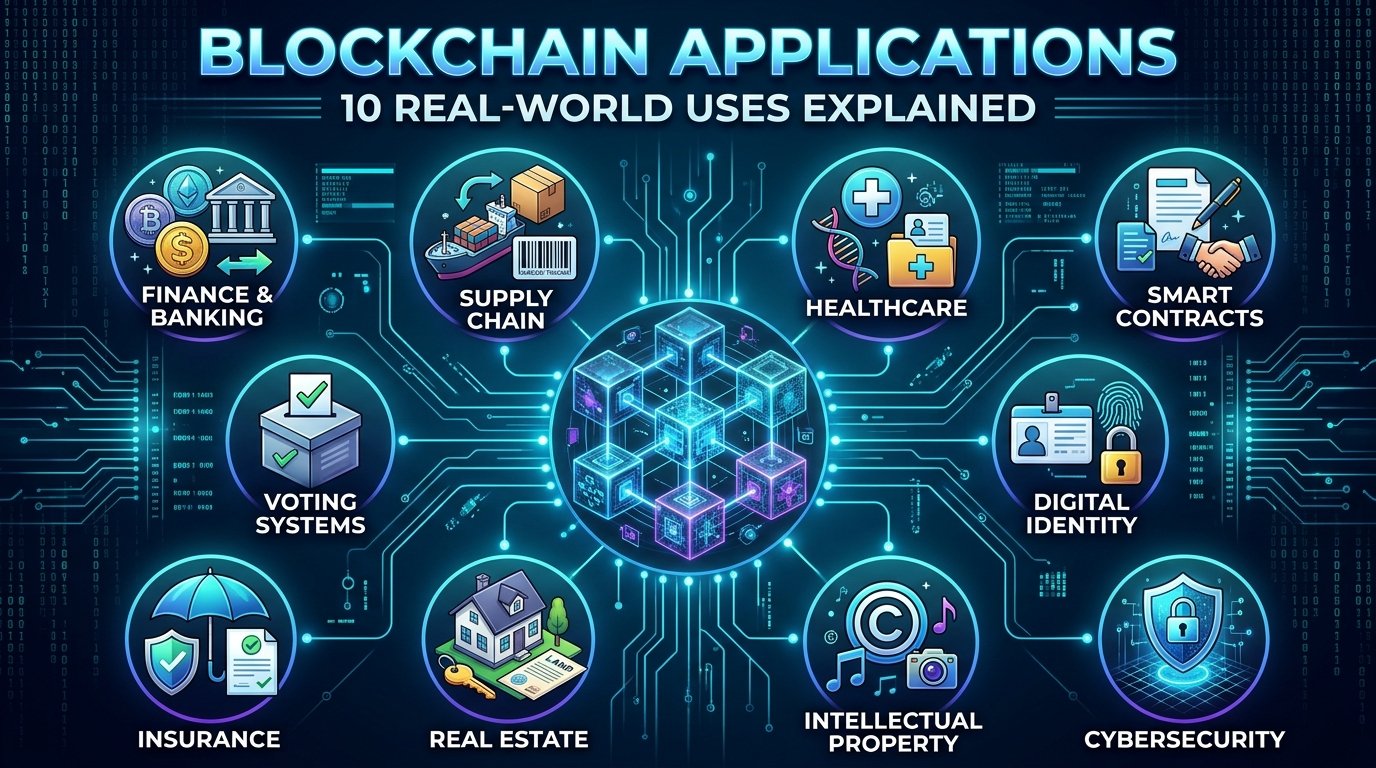
Blockchain applications are the real ways people and companies use blockchain technology. Bitcoin was the first one, but today blockchains also move digital dollars, track food shipments, protect government records and help prove that a document was not changed. Some of these uses work well. Others have failed. This guide explains 10 real examples in simple words, shows where blockchain does not work, and helps you tell real use from hype.
What Is a Blockchain?
A blockchain is a shared record book. Many computers keep the same copy of it, and new entries are added in groups called blocks. Each block is linked to the one before it, which forms a chain. Once a block is added, changing it is very hard because the other computers would have to agree.
Bitcoin uses a blockchain to record who owns which coins. If you are new to this, our guide on what Bitcoin is explains the basics. Other chains, such as Ethereum, can also run small programs called smart contracts. You can read more in our Ethereum guide. A decentralized blockchain platform like this lets developers build apps that no single company controls.
Why Do People Use Blockchain?
- One shared record: Everyone sees the same data, so there are fewer arguments about what is true.
- Hard to change: Old entries are very hard to edit or delete in secret.
- Fewer middlemen: Two parties can deal with each other without a bank or agent in the middle, which can save time and fees.
- Automatic rules: Smart contracts can send money or update a record when set conditions are met.
These benefits matter most when many groups need to share data and do not fully trust each other.
10 Real-World Blockchain Applications
1. Digital Money and Cryptocurrency
The first and biggest use is digital money. Bitcoin lets people send value to anyone in the world without a bank. Other cryptocurrencies work in a similar way, and many add extra features. Prices swing a lot, so most people treat crypto as a risky asset, not everyday cash.
2. Stablecoins and Payments
Stablecoins are crypto tokens built to hold a steady value, usually one US dollar. People like them because you get the speed of a blockchain without the wild price swings. DeFiLlama data shows total stablecoin supply above $300 billion in 2026, with USDT and USDC making up most of it. Companies now use stablecoins for worker payouts, payments between businesses and online checkout, and large payment firms such as Visa and PayPal have added stablecoin options.
3. Cheaper International Money Transfers
Sending money abroad is slow and costly. The World Bank tracks this cost. In early 2025, the global average cost of sending $200 was about 6.49 percent of the amount, and banks were the most expensive option at about 14.55 percent. The United Nations goal is 3 percent or less by 2030.
Stablecoins and blockchain payment networks try to cut this cost by moving money in minutes with fewer middlemen. You can check the latest numbers on the World Bank Remittance Prices Worldwide site. Keep in mind that you may still pay fees to buy and cash out crypto, so compare the full cost before you use it.
4. Tokenized Real-World Assets
Tokenization means turning a claim on a real asset into a digital token. Tokenized US Treasury bills are the clearest example. Funds such as BlackRock’s BUIDL, Franklin Templeton’s BENJI and Ondo’s USDY put government debt on a blockchain, so it can settle faster and pay interest automatically.
Estimates of this market change from tracker to tracker. In 2026 they range from about $19 billion to over $30 billion, depending on what is counted. That is still small next to the almost $28 trillion of US Treasuries that exist.
5. Smart Contracts and DeFi
DeFi means decentralized finance. It uses smart contracts to offer lending, borrowing and trading without a bank. For example, a lending app can match people who want to earn interest with people who want to borrow, and the code handles the rules. DeFi is open to anyone, but it also carries risks such as bugs in the code and scams. Read our guide on crypto risk management before you try any DeFi app.
6. Supply Chain Tracking
Supply chains involve many companies, and records are often on paper. Walmart and IBM tested a blockchain system for food tracing. In a widely reported test, tracing a package of sliced mangoes back to its farm took nearly seven days with paper records and only 2.2 seconds with the blockchain. Faster tracing helps stores remove only the unsafe products during a food recall instead of clearing whole shelves.
7. Drug Verification
Fake medicines are a serious problem. In the United States, the Drug Supply Chain Security Act requires drugs to be tracked as they change hands. A group called MediLedger ran a pilot with the FDA that used a blockchain network so makers, wholesalers and pharmacies could verify drugs without sharing all of their private business data with each other.
8. Government and Health Records
Estonia is a well-known example. In 2016 it chose blockchain-based technology, called KSI, to protect the integrity of records, including the health records of about 1.3 million citizens.
One detail matters a lot here. Patient data is not placed on the blockchain. The chain stores a digital fingerprint of each record, so anyone can check that it was not changed. This is how blockchain can add trust without exposing private data.
9. Land and Property Records
In many countries, land records are messy or easy to forge. In 2016, the Republic of Georgia’s public registry agency began a blockchain-based land registry built with the company Bitfury. Sweden’s land authority has also tested a blockchain system for property sales that lets buyers, sellers, banks and the registry follow each step. The goal is clearer proof of ownership and fewer disputes.
10. Digital Ownership and Royalties
Blockchains can record who owns a digital item, such as a ticket, a game item or a music right. NFTs are the best-known example, and many NFT projects lost most of their value after the hype of 2021. Still, the basic idea of a shared ownership record is being tested for tickets, gaming and royalty payments to artists. This area is still early, so treat big promises with care.
Quick Summary of Blockchain Applications
| Application | Real Example | Main Benefit |
|---|---|---|
| Digital money | Bitcoin | Send value without a bank |
| Stablecoins | USDC, USDT | Fast payments with a steady value |
| Money transfers | Stablecoin remittances | Lower fees, faster delivery |
| Tokenized assets | BlackRock BUIDL | Faster settlement |
| DeFi | Lending apps on Ethereum | Finance without a bank |
| Supply chain | Walmart food tracing | Faster recalls |
| Drug checks | MediLedger FDA pilot | Fewer fake medicines |
| Public records | Estonia KSI | Tamper-proof proof of records |
| Land registry | Georgia, Sweden | Clearer ownership proof |
| Digital ownership | Tickets, game items | Verifiable ownership |
Where Blockchain Has Not Worked
Not every blockchain project succeeds, and TradeLens is a good lesson. The shipping giant Maersk and IBM launched it in 2018 to move global shipping paperwork online. In November 2022 they announced it would shut down, with the platform going offline by the end of the first quarter of 2023.
Maersk said the platform was workable, but full global industry collaboration was not achieved. In simple words, the technology worked, but rival shipping companies did not want to join a system led by a competitor. A blockchain is only useful when enough people agree to use it.
When Does Blockchain Make Sense?
| Blockchain can help when | A normal database is better when |
|---|---|
| Many groups share data and do not fully trust each other | One company controls all the data |
| You need a record that is very hard to change | You need to edit or delete data often |
| You want to cut out middlemen | Speed and low cost matter most |
| Rules can be automated with smart contracts | The data is private and must stay secret |
If one company controls the data, a normal database is usually faster, cheaper and easier to run. Many failed blockchain projects ignored this simple test.
Limits and Risks of Blockchain
- Speed and cost: Some chains are slow or expensive when many people use them at once.
- Privacy: Public blockchains are open, and entries are very hard to delete.
- Rules and laws: Crypto laws are still changing and differ from country to country.
- Scams: Crypto attracts fraud, so never invest because of hype or social media posts.
- Energy use: Bitcoin mining uses a lot of electricity, while many newer chains use much less.
The Bottom Line
Blockchain is not magic and it does not fit every problem. Its strongest uses today are in finance, such as stablecoins and tokenized assets, and in cases where many groups need one trusted record. Look for real users, real results and a clear reason why a blockchain is needed. If those are missing, it is probably hype.
Frequently Asked Questions
What are the main applications of blockchain?
The biggest ones today are cryptocurrency, stablecoin payments, tokenized assets and DeFi. Outside finance, companies and governments use blockchain for supply chain tracking, drug verification and checking that records were not changed.
Is blockchain only used for crypto?
No. Crypto came first, but blockchain technology is also used to track food, check medicines, protect records and register property. Many of these uses do not involve a coin that you trade.
Which industries use blockchain the most?
Finance leads, mainly through stablecoins and tokenized assets. Supply chain, healthcare and government come next, but many projects in those areas are still pilots or small tests.
Is blockchain safe?
The core technology is very hard to tamper with, but the apps, wallets and exchanges built on top of it can have bugs or scams. Using it safely means choosing trusted tools and protecting your private keys.